

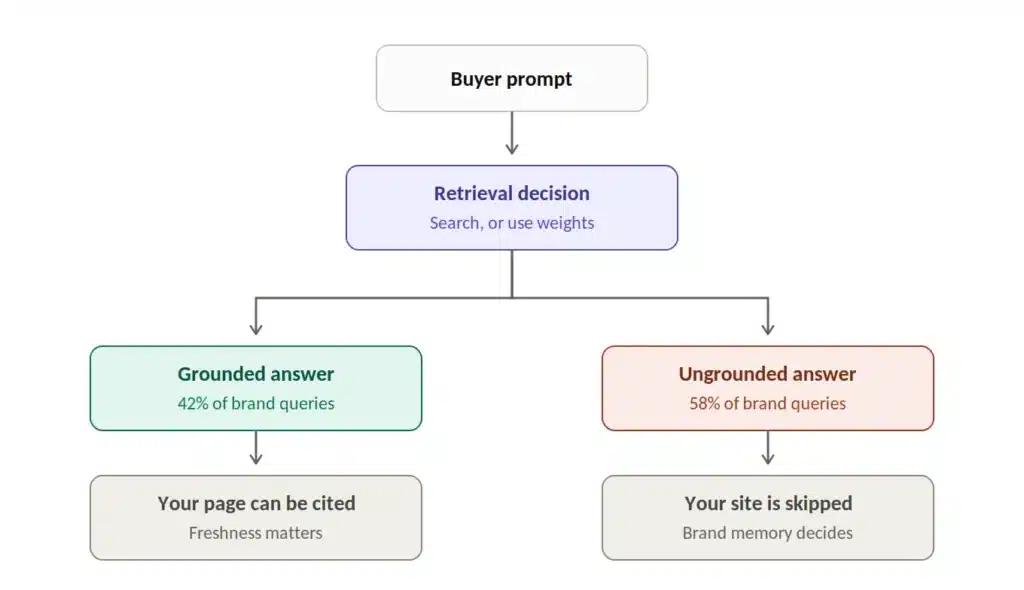
Somewhere between a buyer typing a question and an AI assistant answering it, a decision gets made that only the AI model can see. The system either looks something up or answers from what it already carries around in its weights. That single fork determines whether your website, your case studies, your pricing page, and the post you published last Tuesday have any chance of showing up in the answer.
An answer built from live retrieved sources is grounded. An answer built only from what the model absorbed during pretraining is ungrounded, or parametric. This happens in the same AI chat window, with the same confident tone from the AI, but produces wildly different results for you as a vendor.
The Definition of Grounding
Grounding is the practice of tying a model’s output to an external source of truth at the moment it generates text, rather than trusting whatever was baked into its parameters during training. The dominant technique is retrieval-augmented generation, which is now standard in nearly every commercial assistant. The system takes the question, pulls relevant passages from an index or the live web, drops those passages into the prompt, and writes an answer conditioned on them.
The opposite condition has a proper name too. Parametric knowledge is what the model learned during pretraining and stores in its weights. A recent survey of grounding and evaluation practice (arXiv:2407.12858) describes grounding failures as happening precisely because not everything in a knowledge base makes it into parametric memory. The model isn’t lying to you. It simply doesn’t have the info, and it has no reliable internal signal telling it so.
Google’s Vertex AI documentation is a great place to see the plumbing, because Google actually exposes it. A grounded Gemini response comes back with a groundingMetadata object containing grounding chunks (the retrieved passages that support the answer), grounding supports (which specific segment of the answer maps to which chunk), and the search queries the model generated on its own. There’s also a feature called dynamic retrieval, which lets the system decide per request whether to spend the call on Search or answer from training data. That’s the switch, made explicit and given an API surface.
What this means in practice is that ungrounded answers aren’t wrong so much as frozen and unverifiable. They reflect a snapshot of the web taken months or years before the question was asked. Products differ in how aggressively they retrieve. Perplexity retrieves by default. ChatGPT decides per prompt. Gemini’s grounding is a configuration choice in the API and a background behavior in the consumer product.
The Retrieval Decision Happens Before Any of Your SEO
Every assistant makes a routing call before it does anything you can influence. If the router says no, your schema markup, your page speed, your beautifully structured comparison table, and your six months of content investment are all sitting outside the building.
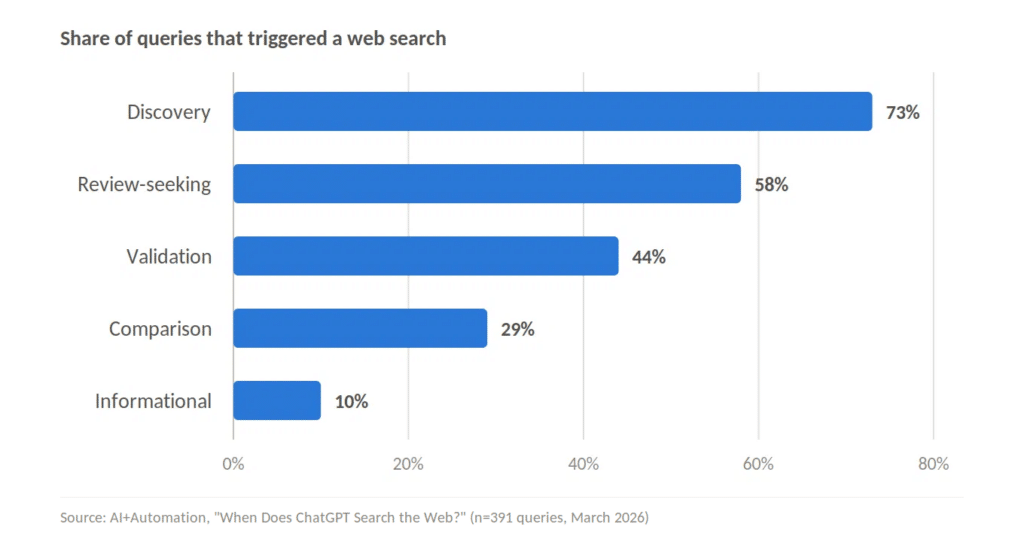
A March 2026 study by AI+Automation ran 400 brand and product queries through the ChatGPT web interface using Playwright, capturing the SSE stream to detect fan-out searches directly rather than inferring from citations. Of the 391 valid responses, 42% triggered a web search. The other 58% were answered entirely from training data. Broken down by intent, the spread is dramatic: discovery queries (“best CRM for small business”) triggered retrieval 73% of the time, review-seeking 58%, validation 44%, comparison 29%, and plain informational queries (“what is a CRM”) just 10%.
Nectiv analyzed more than 8,500 prompts across nine industries and found 31% triggered at least one search, averaging 2.17 searches per prompt. Semrush’s clickstream analysis covering 17 months found the share of search-enabled ChatGPT sessions swinging between 15% and 66.3% depending on the month and model version, which tells you the switch itself is a moving target that OpenAI adjusts without announcement.
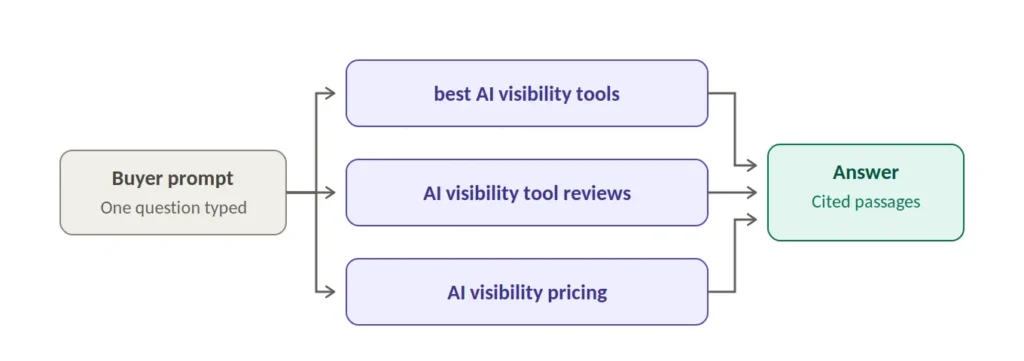
When retrieval does fire, the system doesn’t just run your question verbatim. It performs query fan-out, decomposing one prompt into multiple synthetic sub-queries that chase different facets of intent, then retrieves and scores content at the passage level before synthesizing. Google described the mechanism in patent application US20240289407A1, and the industry borrowed the term for the equivalent behavior in ChatGPT and Claude.
Why B2B Experiences This More Than Anyone
Business buyers have moved into these tools faster than almost anyone predicted. Forrester’s 2026 buyers’ survey, covering nearly 18,000 global business buyers, found 94% used generative AI somewhere in their purchase process, up from 89% the year before. More striking than the adoption number is the ranking: twice as many buyers named generative AI or conversational search as their most meaningful research source than named any other source, including vendor websites, product experts, and sales reps.
The specific behaviors are interesting as well. Roughly 55% compare vendors inside AI tools, 54% research products, and 47% build their internal business case before they ever contact a vendor. Gartner’s late-2025 survey of 645 B2B buyers put GenAI usage for vendor and product information at 45%, and its May 2026 research found buyers now consult an average of seven sources while 69% still ask a sales rep to validate what the AI told them. Gartner also predicts that by 2027, 40% of B2B commercial leaders will stand up dedicated generative search teams.
Now overlay that on the retrieval data. Your shortlist is being assembled inside a system that answers most informational questions without looking at the web at all, and B2B content libraries are famously stuffed with exactly the informational content that triggers retrieval least. Category queries (“best email marketing platform”) triggered search 59% of the time in the AI+Automation study. Brand queries (“what is Mailchimp”) triggered it 39%. The difference between where you’ve invested time and effort (especially in SEO content) and where retrieval actually happens is, for most B2B sites we audit, embarrassingly backward.
Ungrounded Answers (Usually) Belong to the Incumbents
When a model answers from parametric memory, it is reproducing statistical associations built up from how often, how consistently, and how authoritatively your brand appeared across the training data. That mechanism structurally favors whoever was already well-known when the crawl happened.
There’s clean experimental evidence for this. A 2026 study on RAG context injection (arXiv:2606.09204) ran a no-retrieval control condition, asking models to recommend products using parametric knowledge alone across 100 trials each. Well-known incumbents dominated completely. GPT-4o-mini put Apple’s product in the top two 100% of the time and Sony’s 95% of the time. The challenger brand the researchers were tracking appeared in the top two exactly zero times. Different category, identical mechanism to the one deciding your vendor shortlist.
The second problem is drift. Whatever the model believes about you was fixed at the training cutoff, so a rebrand, a repositioning, an acquisition, a new product line, or a pricing change simply doesn’t exist in the ungrounded answer. We’ve watched models describe a client’s discontinued product as their flagship offering with total composure. Nobody involved was being dishonest. The model was just confidently reciting 2023.
Ungrounded answers do most of their damage right here, because they’re indistinguishable from grounded ones at the interface. Same formatting, same authoritative tone, no citations to inspect. The buyer has no way to tell whether the shortlist they just got reflects the current market or a stale snapshot, and Forrester’s 2025 research found 20% of buyers actually felt less confident in a decision after running into unreliable AI output.
Being the Underdog Can Be An Advantage Here!
Something counterintuitive falls out of all this. If the model doesn’t recognize your brand, it has to go look. Brand familiarity behaved as a near-binary signal in both of the AI+Automation experiments: unfamiliar brands forced retrieval every time, familiar ones got answered from memory.
That flips the usual “incumbent” scenario. For a challenger, retrieval is the prize! It’s the entire opportunity, and it’s the part you can influence this quarter rather than over the three or four years it takes to accumulate enough training data presence to be recognized without a search. Comparison pages follow the same logic. “Salesforce vs. HubSpot” gets answered from memory and your page never enters the conversation. “Your brand vs. the household name in your category” forces a lookup, and the page you wrote is exactly the kind of source the system is hunting for.
Being nobody’s first guess has never been quite this useful. But the advantage only pays if what the model finds is actually worth citing. The original GEO study from Aggarwal and colleagues (KDD 2024, arXiv:2311.09735) tested roughly 10,000 queries across nine datasets and found that classic SEO signals like keyword density barely moved citation probability, while content carrying statistics, cited sources, and quotations from credible authorities improved visibility by up to 40%. Later work in the same line has found structural features matter too, because retrieval operates on passages and a page that reads coherently at the chunk level gets pulled more often than one that only makes sense end to end.
This Calls for Two Seperate Optimization Initiatives
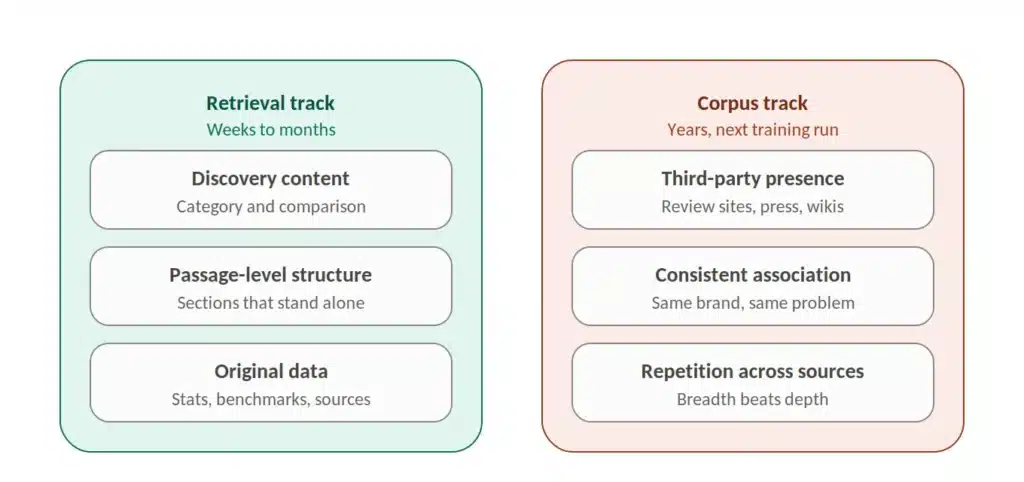
Once you separate grounded from ungrounded, the work splits cleanly into two efforts running on completely different clocks, and most teams are accidentally funding only one of them.
The retrieval side is fast, measurable, and mostly technical. It covers the queries where the model does look, and it’s where a quarter of focused work produces visible movement:
- Build for discovery and category intent, where retrieval rates run 59% to 73%, rather than pouring everything into definitional content sitting in the 10% zone
- Structure pages so individual sections stand on their own, since passages get retrieved, not documents
- Publish original data, benchmarks, and named sources rather than restating what the model already knows
- Make sure AI crawlers can actually reach the content, which is a boring audit that catches an alarming number of problems
- Keep comparison content pointed at matchups where you’re the unfamiliar name
The corpus (training data) side is slow, indirect, and mostly editorial. You cannot edit training data, but you can influence what the next crawl contains: third-party review platforms, industry press, analyst coverage, Wikipedia and Crunchbase entries, podcast appearances, and consistent association between your brand name and a specific problem across many independent sources. Repetition across unrelated sources is what builds the association. Depth on your own domain does not substitute.
The two reinforce each other, which is the part worth planning around. A brand the model already half-recognizes gets a credibility boost when it also turns up in live retrieval, and a brand that keeps appearing in retrieved results keeps generating the kind of third-party mentions that eventually feed the next training run.
Measure the Switch Along With Your Brand Mentions
For every prompt in your tracked set, capture three things: did retrieval fire, what share of the citations were yours when it did, and what the model said about you when it didn’t. That last item is the one nobody tracks, yet it’s crucial because it shows you exactly what your brand looks like, frozen in amber.
Then run everything more than once. A 2026 paper on statistical measurement in generative search (arXiv:2603.08924) points out that reported visibility improvements across the GEO literature typically arrive without confidence intervals, making it impossible to know whether an improvement cleared the noise floor of the measurement itself. Single-run monitoring will hand you dramatic week-over-week swings that are pure variance. Queries near the retrieval decision boundary can flip on identical input.
What To Look At First
If you do one thing after reading this, pull twenty prompts your buyers would realistically type, run them through ChatGPT, Gemini, Claude, and Perplexity, and sort the responses by whether citations appeared. You’ll have your grounded-to-ungrounded ratio in an afternoon, and it will probably reorder your content roadmaps.
The optimizers getting this right (ahem, like Ice Nine Online) have stopped treating AI visibility as one problem. We’re playing offense on retrieval, where the wins are near-term, and the underdogs have room to move, while building the third-party presence that shapes how models describe them the next time somebody trains one.
Run This Against Your Own Prompt Set
Measuring your own grounding rate is a weekend of work if you have someone comfortable with the APIs and a tolerance for parsing SSE streams. If you would rather have it done, that is part of what our generative engine optimization services cover. We build the prompt set from your category and your buyers’ actual phrasing, run it across ChatGPT, Gemini, and Claude with enough repetitions to separate real movement from variance, and report grounding rate, citation share, and the verbatim claims each platform makes about you when it does not search.
Want help with this? Get in touch and send over the twenty prompts you would most want to win.
Sources referenced
- Lewis et al., Retrieval-Augmented Generation for Knowledge-Intensive NLP Tasks, NeurIPS 2020
- Grounding and Evaluation for Large Language Models: Practical Challenges and Lessons Learned, arXiv:2407.12858
- Aggarwal et al., GEO: Generative Engine Optimization, ACM SIGKDD 2024, arXiv:2311.09735
- The Injection Paradox: Brand-Level Suppression in Safety-Trained LLM Recommendations via RAG Context Injection, arXiv:2606.09204
- Quantifying Uncertainty in AI Visibility: A Statistical Framework for Generative Search Measurement, arXiv:2603.08924
- Google Cloud, Grounding with Google Search / Vertex AI grounding documentation
- AI+Automation, When Does ChatGPT Search the Web? AI Citation Triggers Across 391 Queries, March 2026
- Nectiv via Search Engine Land, ChatGPT performs a search in 31% of prompts, October 2025
- Semrush, ChatGPT traffic analysis: Insights from 17 months of clickstream data, April 2026
- Forrester, State of Business Buying / 2026 Buyers’ Survey
- Gartner B2B buyer research, 2025 and 2026
- Google patent application US20240289407A1 (query fan-out)
About the Author

Share this Post